Pipe Smoking Terms: The Complete Guide to Pipe Terminology
If you are new to the world of pipe smoking, you have probably encountered words that seem confusing at first. Terms such as bowl, chamber, shank, stem, cake, Latakia, flake, draft, mortise, tenon, and cadence are part of the everyday language of experienced pipe smokers.
Understanding pipe smoking terms is more than learning a collection of unfamiliar words. Knowing the terminology makes it easier to choose a pipe, understand pipe descriptions, select tobacco, learn proper smoking techniques, and take care of your pipes.
This guide brings together the most important pipe terminology in one place, with clear explanations for beginners and useful details for more experienced smokers.
Pipe Parts and Anatomy
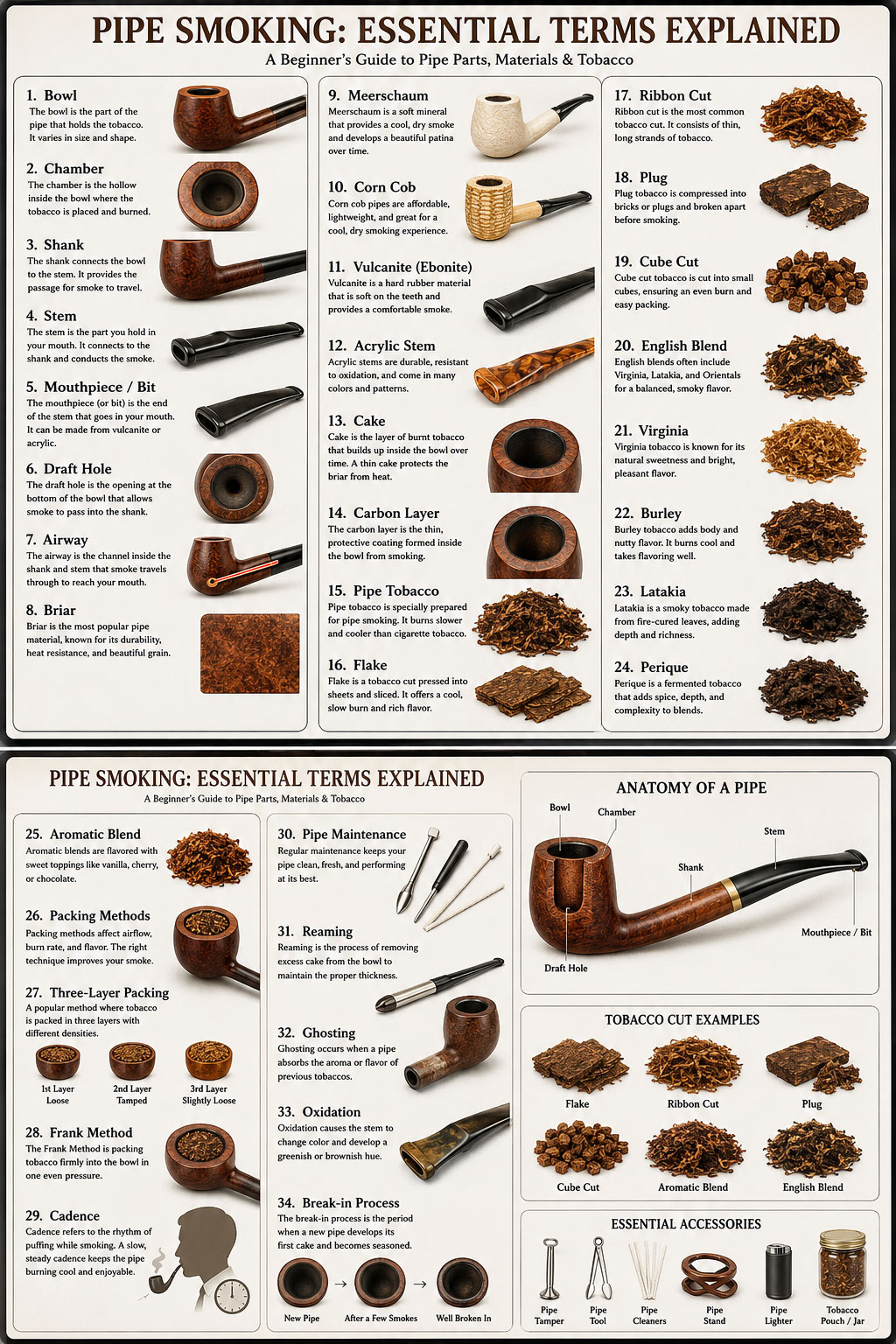
Bowl
The bowl is the main body of a tobacco pipe. It contains the tobacco chamber and is usually the part you hold while smoking.
Bowl size and shape influence the amount of tobacco the pipe can hold, the length of a smoke, and the overall character of the pipe.
Chamber
The chamber is the hollow space inside the bowl where the tobacco is packed and burned.
Its diameter, depth, and shape can affect how a tobacco blend burns and how long a smoke lasts. The chamber is also sometimes referred to as the tobacco chamber or smoking chamber.
Rim
The rim is the upper edge of the bowl surrounding the chamber opening.
The rim is an important part of a pipe’s appearance and may be smooth, rusticated, stained, or otherwise finished depending on the pipe’s design.
Shank
The shank is the section connecting the bowl to the stem. The airway runs through the shank, carrying smoke from the chamber toward the stem.
The length and design of the shank are also important elements in traditional pipe shapes.
Stem
The stem is the removable section that extends from the shank to the smoker’s mouth.
Pipe stems can be straight or bent and are commonly made from materials such as ebonite (vulcanite) or acrylic.
Mouthpiece / Bit
The mouthpiece, often called the bit, is the end of the stem held between the smoker’s teeth or lips.
The shape, thickness, and button design of the bit can have a significant effect on comfort during a smoke.
Airway
The airway is the internal passage through which air and smoke travel from the tobacco chamber to the mouthpiece.
A well-designed airway should provide a smooth, unobstructed draw.
Draft Hole
The draft hole is the opening at the bottom of the tobacco chamber where the airway meets the chamber.
Its position is important because it affects how evenly the tobacco burns and how much tobacco remains after the smoke.
Mortise and Tenon
The mortise and tenon form the connection between the shank and stem.
The mortise is the receiving opening in the shank, while the tenon is the projecting part of the stem that fits into it.
This joint must be properly aligned to provide a secure connection and a smooth airway.
Foot and Heel
The heel is the bottom inside portion of the bowl, beneath the tobacco chamber.
The foot generally refers to the bottom exterior portion of the bowl.
These terms are particularly useful when discussing traditional pipe shapes and construction.
Common Pipe Materials
Briar
Briar is the most widely used traditional material for quality tobacco pipes.
It comes from the burl of Erica arborea, commonly known as tree heath, which grows around the Mediterranean region. Briar is valued for its heat resistance, durability, porosity, and attractive grain.
Because of these properties, briar has become the standard material for many handmade and factory-made smoking pipes.
Meerschaum
Meerschaum is a naturally occurring mineral that is particularly valued for pipe making because of its light weight and heat-resistant properties.
Meerschaum pipes are also famous for developing a distinctive coloration over time as they are smoked.
Corn Cob
A corn cob pipe is made from the dried cob of a corn plant.
Corn cob pipes are lightweight, inexpensive, and easy to smoke, making them a popular choice for beginners as well as experienced smokers who appreciate their simplicity.
Ebonite / Vulcanite
Ebonite, also known as vulcanite, is a hardened form of rubber commonly used for pipe stems.
It has a softer feel than acrylic but can oxidize over time when exposed to oxygen, light, saliva, and heat. Oxidized ebonite often develops a greenish or brownish appearance.
Acrylic
Acrylic is a durable synthetic material frequently used for pipe stems.
Unlike ebonite, acrylic does not normally oxidize, and it is available in a wide variety of colors and patterns. Some smokers, however, prefer the softer feel of ebonite.
Pipe Tobacco Terms
Pipe Tobacco
Pipe tobacco refers to tobacco specially prepared for smoking in a tobacco pipe.
It is available in different cuts, moisture levels, blends, and processing methods, each of which can influence the way the tobacco packs, burns, and tastes.
Virginia
Virginia is one of the most widely used pipe tobacco varieties.
Virginia leaf is known for its natural sweetness and is used as the foundation of many blends. It can appear in both aromatic and non-aromatic mixtures.
Burley
Burley is known for its relatively low natural sugar content and characteristic nutty, earthy flavor.
It is often used to provide body and strength to pipe tobacco blends and is also valued for its ability to absorb added flavorings.
Latakia
Latakia is a distinctive pipe tobacco traditionally produced through a smoke-curing process.
It is famous for its smoky, woody, earthy and sometimes leathery character. Latakia is particularly associated with traditional English-style and Balkan-style blends.
Perique
Perique is a distinctive tobacco traditionally associated with Louisiana.
It undergoes a specialized fermentation process that gives it a rich, spicy and dark character. It is generally used in relatively small quantities to add depth and complexity to blends.
Cavendish
Cavendish is not simply a particular tobacco variety. It generally refers to a method of processing and preparing tobacco, often involving pressing and the addition of flavorings.
Cavendish is especially common in aromatic pipe tobacco blends.
Pipe Tobacco Cuts
The term tobacco cut describes the physical form in which pipe tobacco is prepared. Different cuts can affect packing, airflow, moisture, and the rate at which the tobacco burns.
Ribbon Cut
Ribbon cut consists of long, relatively thin strips of tobacco.
It is one of the most common pipe tobacco cuts and is generally easy to pack and prepare.
Flake
Flake tobacco is produced by pressing tobacco into dense blocks and slicing the pressed tobacco into thin pieces.
Flake can be smoked as it comes, folded, or rubbed out into smaller strands before packing.
Plug
Plug tobacco is compressed into a dense block.
The smoker can cut a portion from the plug and prepare it according to personal preference. Because of its dense structure, plug tobacco can also store well.
Cube Cut
Cube cut tobacco consists of small, roughly square pieces.
This cut is often associated with Burley and can provide a relatively slow-burning smoking experience.
Shag Cut
Shag is a very fine tobacco cut, consisting of narrow, thread-like strands.
Because it is finer than standard ribbon cut, shag can burn relatively quickly and generally requires a lighter packing technique.
Rope / Twist
Rope or twist tobacco is made by twisting tobacco leaves into a dense rope-like form.
The smoker can cut slices or coins from the rope and prepare them for smoking.
Coin
A coin is a round slice cut from rope or twist tobacco.
Coins can be smoked in their original form or broken apart before packing.
Rubbed Out
Rubbed out refers to flake or another compressed tobacco that has been broken apart into smaller strands before smoking.
Some smokers prefer rubbing out flake because it makes packing and lighting easier.
Pipe Tobacco Blend Terms
English Blend
An English blend traditionally refers to a tobacco mixture built around tobaccos such as Virginia, Latakia, and Oriental or other supporting tobaccos.
These blends are generally associated with smoky, earthy and complex flavor profiles.
Aromatic Blend
An aromatic blend is pipe tobacco that has been flavored or topped with additional aromas such as vanilla, chocolate, cherry, caramel, coffee, or other flavorings.
Aromatic blends are often attractive to beginners because of their noticeable room aroma and flavor characteristics.
Non-Aromatic
A non-aromatic blend does not rely on added flavorings to create its primary character.
Instead, the smoker experiences the natural characteristics of the tobacco varieties and the way they have been cured, blended, pressed, or fermented.
Pipe Packing and Smoking Terms
Packing
Packing is the process of filling the tobacco chamber with pipe tobacco.
The goal is to create enough resistance for a comfortable draw while allowing sufficient airflow for the tobacco to burn evenly.
Three-Layer Method
The three-layer method is a traditional packing technique in which tobacco is placed into the chamber in stages, with each layer receiving progressively greater pressure.
The exact pressure varies from smoker to smoker and depends on the tobacco cut and moisture level.
Frank Method
The Frank Method is a packing technique in which tobacco is formed and placed into the chamber as a cohesive mass before being adjusted and tamped.
As with other packing methods, the objective is a balanced combination of airflow, density, and an even burn.
Tamp / Tamping
Tamping means gently pressing the burning tobacco downward with a pipe tamper.
The purpose is not to compress the tobacco aggressively, but to maintain an even ember and restore the proper draw when necessary.
Cadence
Cadence refers to the rhythm and frequency of a smoker’s puffs.
A slow, controlled cadence generally helps keep the pipe cooler and reduces the risk of overheating. Learning to control cadence is one of the most important skills for a new pipe smoker.
Draw
The draw is the act of drawing air and smoke through the pipe.
Pipe smokers often describe a well-engineered pipe as having an open or easy draw, meaning that it provides comfortable airflow without requiring excessive effort.
Relight
A relight occurs when the tobacco ember goes out and the smoker lights it again.
Relighting is completely normal in pipe smoking and can happen several times during a bowl, particularly when smoking slowly.
Dottle
Dottle refers to the small amount of spent tobacco that remains at the bottom of the bowl after smoking.
A properly packed and smoked pipe should generally leave only a relatively small amount of dottle.
Pipe Maintenance Terms
Pipe Maintenance
Pipe maintenance includes cleaning, drying, polishing, reaming, and other practices used to keep a pipe in good condition.
Regular maintenance can help preserve both the appearance and smoking performance of a pipe.
Pipe Cleaner
A pipe cleaner is a flexible cleaning tool used to remove moisture, residue, and tobacco debris from the airway and stem.
Pipe cleaners are among the most basic and essential accessories for pipe smokers.
Reaming
Reaming is the process of carefully removing excess cake from the inside of a pipe bowl.
A controlled layer of cake can protect briar from excessive heat, but an excessively thick layer can create problems and should be reduced carefully with an appropriate reamer.
Cake
In pipe terminology, cake refers to the layer of carbon that gradually develops inside a briar pipe’s tobacco chamber.
A controlled layer can help protect the briar, but excessive cake should not be allowed to build up because it can contribute to uneven heating and potentially damage the bowl.
Bowl Coating
Some new pipes are sold with a bowl coating applied to the inside of the chamber.
The purpose is generally to help protect the briar during the early smokes and encourage the development of an even cake. The use and type of bowl coating vary among pipe makers.
Ghosting
Ghosting occurs when the flavor or aroma of a previously smoked tobacco remains in a pipe and influences the flavor of a subsequent tobacco.
Some pipe smokers deliberately dedicate individual pipes to particular tobacco families to minimize unwanted ghosting.
Oxidation
Oxidation is most commonly discussed in relation to ebonite or vulcanite stems.
Over time, exposure to oxygen, light, heat, and moisture can cause an ebonite stem to lose its original dark appearance and develop a greenish or brownish tone.
Break-In
The break-in period refers to the first several smokes in a new briar pipe.
During this period, the smoker gradually develops a protective cake inside the chamber while becoming familiar with the pipe’s smoking characteristics.
Rotation
A pipe rotation is a group of pipes that a smoker alternates between rather than smoking the same pipe repeatedly.
Rotating pipes gives each pipe time to dry between smokes and is a common practice among experienced pipe smokers.
Common Pipe Shape Terms
Pipe terminology also includes names that describe traditional pipe shapes. Some of the most recognizable include:
- Billiard — a classic straight-sided bowl with a cylindrical chamber.
- Dublin — a bowl that generally tapers toward the heel.
- Apple — a rounded bowl with an apple-like profile.
- Bulldog — commonly recognized by its diamond-shaped shank and distinctive bowl profile.
- Rhodesian — related to the Bulldog family but typically featuring a rounded bowl.
- Pot — a shorter, wider version of a traditional Billiard.
- Bent — a pipe with a curved shank and/or stem.
- Churchwarden — a pipe characterized by its exceptionally long stem.
- Calabash — a distinctive shape historically associated with the classic gourd pipe.
- Canadian — a long-shanked pipe with a characteristic oval shank.
- Poker — a pipe designed with a flat base that allows it to stand upright.
- Freehand — a pipe whose form is largely determined by the natural grain and shape of the briar rather than a strict traditional shape.
There are dozens of traditional pipe shapes and many variations between them. Shape terminology can also vary somewhat between makers and collectors.
Pipe Finishes and Grain Terms
Smooth
A smooth finish leaves the surface of the briar relatively polished and allows the natural grain to remain visible.
Rusticated
A rusticated pipe has a deliberately textured exterior surface created by carving or mechanically working the briar.
Rustication can emphasize the character of the bowl while also providing a distinctive appearance.
Sandblasted
A sandblasted finish uses abrasive blasting to reveal and emphasize the natural grain structure of the briar.
High-quality sandblasting can produce deep, dramatic grain patterns.
Birdseye
Birdseye describes a distinctive grain pattern that appears as small circular or oval markings across the surface of briar.
It is particularly noticeable on certain areas of a briar block and is often appreciated by pipe collectors.
Straight Grain
Straight grain refers to grain lines that run relatively parallel along the surface of the pipe.
Straight-grain briar is highly valued by many collectors because of its visual appeal and the craftsmanship required to orient the pipe around the grain.
Grade
A pipe’s grade is a designation used by many makers to communicate aspects of the briar, grain, craftsmanship, finish, or overall quality.
There is no universal grading system across all pipe makers, so the meaning of a particular grade can differ from one manufacturer to another.
Why Understanding Pipe Terminology Matters
Learning pipe smoking terms gives you a common language for understanding almost everything related to the hobby.
When you know what a bowl, chamber, shank, stem, draft hole, mortise, tenon, cake, flake, ribbon cut, Latakia, cadence, or ghosting means, product descriptions and pipe-smoking guides become much easier to understand.
More importantly, terminology helps you make better decisions. You can compare pipe shapes, understand the characteristics of different materials, choose a tobacco cut that suits your smoking style, and communicate more precisely with other pipe smokers and pipe makers.
Think of this glossary as a starting point rather than an endpoint. The world of pipes has a vocabulary shaped by centuries of craftsmanship, tobacco blending, collecting, and smoking traditions. The more familiar you become with that vocabulary, the easier it becomes to appreciate the details that make every pipe and every tobacco blend different.
Pinocchio Pipe will continue to explore these terms, techniques, materials, tobacco blends, pipe shapes, and traditions in greater depth so that both new and experienced pipe smokers can make better-informed choices and enjoy the craft of pipe smoking more fully.
References: