Choosing your first smoking pipe can be exciting, but it can also be confusing. With hundreds of shapes, materials, finishes, brands, and price ranges available, a new pipe smoker may not know where to start.
Should you buy a branded pipe? Is briar really the best material? Do you need a filter? Which accessories are essential? And how much should you spend on your first tobacco pipe?
The right answer depends on your smoking habits, experience, and personal preferences. However, there are several important factors every smoker should consider before buying a pipe.
This guide explains how to choose a smoking pipe, what to look for in a quality pipe, which accessories you actually need, and what beginners should know before making their first purchase.
1. Choose the Right Pipe Material
One of the first things to consider when buying a tobacco pipe is the material from which it is made.
Briar Pipes
Briar is the traditional material used for many quality smoking pipes.
It comes from the burl of the Erica arborea tree and is valued for its resistance to heat, durability, and ability to produce attractive grain patterns.
Because briar requires careful curing, shaping, drilling, and finishing, handmade briar pipes can vary considerably in price.
For many smokers, a well-made briar pipe offers an excellent balance between durability, performance, and craftsmanship.
Meerschaum Pipes
Meerschaum is a naturally occurring mineral that is lightweight and highly heat resistant.
Meerschaum pipes are particularly appreciated for their ability to develop distinctive coloration as they are smoked. They are also popular among collectors because of their craftsmanship and often intricate carving.
Corn Cob Pipes
Corn cob pipes are inexpensive, lightweight, and easy to smoke.
They can be an excellent choice for someone who wants to experiment with pipe smoking without making a significant investment.
2. Should You Buy a Branded Pipe?
Buying a pipe from an established maker can be a good way to reduce uncertainty, especially when you are still learning how to evaluate pipe quality.
A reputable pipe maker generally has established standards for drilling, materials, construction, and finishing.
However, brand name alone does not guarantee that a pipe is right for you.
Instead of choosing a pipe simply because it carries a famous name, consider:
- The quality of the material
- The drilling and airway
- The stem-to-shank connection
- The finish
- The shape and weight
- The comfort of the mouthpiece
- The reputation of the maker or retailer
- Your own budget and smoking preferences
Many established brands offer entry-level pipes alongside higher-grade handmade models. This makes it possible for beginners to buy from a recognized maker without necessarily spending a large amount of money.
3. Choose a Pipe Shape You Actually Like
Pipe shape is not purely a matter of appearance. The shape, size, weight, and balance of a pipe all contribute to the smoking experience.
Popular traditional shapes include:
- Billiard
- Dublin
- Apple
- Bulldog
- Pot
- Bent
- Canadian
- Poker
- Churchwarden
A straight pipe may appeal to someone who prefers a classic, balanced design, while a bent pipe can feel more comfortable for smokers who like to hold the pipe in their mouth.
There is no universally “best” pipe shape.
Your first pipe should be comfortable in your hand and mouth and should suit the amount of time you normally have available for a smoke.
4. Look at the Pipe’s Size and Weight
A pipe can look beautiful in photographs but feel completely different in your hand.
Before buying, consider:
Bowl Size
A larger bowl generally holds more tobacco and can provide a longer smoking session.
A smaller chamber may be more appropriate if you prefer shorter smoking sessions or want to smoke smaller amounts of tobacco.
Weight
A heavy pipe can become uncomfortable when held in the teeth for a long period.
If you enjoy clenching your pipe while reading, working, or drinking coffee, a lighter pipe may be more comfortable.
Stem Length
Longer stems can change the balance and feel of a pipe.
Very long stems, such as those found on Churchwarden pipes, create a distinctive smoking experience but are not necessarily the most practical choice for every beginner.
5. Pay Attention to the Airway
One of the most important things to consider when buying a smoking pipe is the airway.
A well-made pipe should have a properly drilled airway that provides a comfortable and consistent draw.
The airway connects the chamber to the stem and mouthpiece. Poor alignment, excessive restrictions, or rough drilling can negatively affect the smoking experience.
If you are buying your first pipe, purchasing from a reputable pipe maker or knowledgeable retailer can help because experienced sellers can often identify construction problems that are difficult for beginners to recognize.
6. Check the Mouthpiece
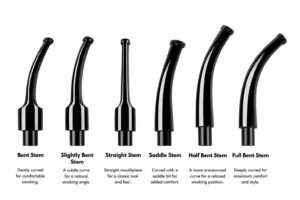
The mouthpiece is the part of the pipe that you hold between your lips or teeth, so comfort matters.
Pay attention to:
- Thickness
- Shape
- Button design
- Material
- Overall balance
Pipe stems are commonly made from ebonite/vulcanite or acrylic.
Ebonite is often appreciated for its softer feel, while acrylic is durable and resistant to oxidation.
The best choice ultimately comes down to personal preference.
7. Do You Need a Pipe Filter?
Some tobacco pipes are designed to accept filters, while others are completely filterless.
A common size is the 9mm filter, although different pipe systems are available.
Two commonly encountered filter materials are:
Balsa Filters
Balsa filters are made from lightweight balsa wood and are designed primarily to absorb moisture from the smoke.
Activated Carbon Filters
Activated carbon filters are designed to absorb moisture and some components of the smoke.
Whether a smoker prefers filtered or unfiltered pipes is largely a matter of personal preference.
A filter is not automatically an indication of a better-quality pipe, and a filterless pipe is not necessarily inferior.
The important thing is understanding which system a pipe uses before buying it.
8. Buy the Essential Pipe Accessories
A pipe itself is only part of the experience.
Fortunately, you do not need a huge collection of accessories to get started.
Pipe Tool or Tamper
A pipe tool is one of the most useful accessories for a pipe smoker.
Traditional three-in-one pipe tools usually include:
- A tamper
- A pick
- A scraper or spoon
The tamper is used to gently adjust the tobacco and maintain the ember during smoking.
The pick can help with airflow or loosen compacted tobacco, while the scraper can be useful for cleaning tobacco residue from the bowl.
A quality tamper does not need to be complicated or expensive.
Pipe Cleaners
Pipe cleaners are essential for basic pipe maintenance.
After smoking, a pipe cleaner can be passed through the stem and airway to remove moisture and tobacco residue.
Regular cleaning helps maintain airflow and reduces the accumulation of stale tobacco deposits.
For smokers who use their pipes frequently, having a supply of good-quality pipe cleaners is far more important than buying a large collection of decorative accessories.
Pipe Cleaning Solution
For deeper routine cleaning, a pipe-cleaning solution can be useful.
It can help remove accumulated residue from the stem and airway when a dry pipe cleaner is not enough.
However, strong solvents should not be used indiscriminately. Alcohol, thinner, acetone, and industrial cleaning products may damage certain finishes or pipe materials.
Always use a product appropriate for pipe maintenance and follow its instructions.
9. Choose Your Pipe Tobacco Carefully
Choosing a pipe is only half of the equation. The tobacco you put into it has an enormous influence on your smoking experience.
Pipe tobacco comes in many styles, cuts, strengths, and flavor profiles.
Aromatic Tobacco
Aromatic blends are treated with flavorings that can include vanilla, chocolate, cherry, coffee, caramel, and other aromas.
They are often attractive to beginners because of their noticeable flavor and room aroma.
Virginia Tobacco
Virginia is naturally sweet and is one of the most important components in many pipe tobacco blends.
Burley Tobacco
Burley is known for its nutty, earthy character and is commonly used to add body and strength to blends.
Latakia
Latakia is famous for its smoky, earthy, woody character and is an important component of many traditional English-style blends.
There is no single “best pipe tobacco for beginners.” The best choice depends on personal taste, smoking cadence, nicotine preference, and previous experience.
10. Learn How to Smoke a Pipe Properly
Even the most beautifully made pipe will not perform at its best if it is smoked incorrectly.
One of the most important beginner skills is learning to smoke slowly.
Smoking too aggressively can make the pipe excessively hot and may cause tongue irritation, commonly called tongue bite.
A good pipe-smoking technique involves:
- Packing the tobacco correctly.
- Lighting it gently.
- Taking slow, controlled puffs.
- Using the tamper when necessary.
- Allowing the pipe to cool if it becomes too hot.
- Relighting when necessary rather than trying to keep an aggressive ember.
Pipe smoking is not a race.
The goal is a relaxed, controlled cadence that allows the tobacco to burn steadily while keeping the pipe at a comfortable temperature.
11. Consider Buying More Than One Pipe
Once you become more experienced, having several pipes can be beneficial.
A pipe rotation allows individual pipes to rest and dry between smokes.
Different pipes can also be dedicated to different tobacco families. For example, some smokers prefer to keep one pipe for aromatic blends and another for Latakia-rich or Virginia-based tobaccos.
This can help reduce unwanted ghosting, where the character of a previous tobacco remains in the pipe and influences later smokes.
You do not need a large collection when you are starting. One good pipe is enough to learn the fundamentals.
As your preferences develop, you can gradually build a collection around the shapes, materials, and tobacco styles you enjoy most.
12. Buy From a Reliable Seller
Where you buy your pipe matters almost as much as which pipe you choose.
A reliable seller should provide clear information about:
- Pipe material
- Maker or brand
- Dimensions
- Weight
- Bowl capacity
- Filter system
- Shape
- Finish
- Condition
- Origin
A knowledgeable seller can also help beginners choose a pipe that matches their budget and smoking habits.
For handmade pipes, photographs alone do not always tell the entire story. Information about the maker, construction, drilling, and materials can be just as important as the appearance of the pipe.
Pinocchio Pipes: Handmade Italian Pipe Craftsmanship
Pinocchio Pipes was created with the idea that authentic pipe smoking should be accessible to enthusiasts who appreciate craftsmanship without necessarily entering the highest price levels of the market.
The brand focuses on smoking pipes made by skilled Italian artisans, combining traditional pipe-making techniques with distinctive designs and accessible pricing.
For smokers who are looking for a pipe that feels personal rather than mass-produced, an artisan-made pipe can offer something beyond functionality: the character of handmade craftsmanship.
As with any pipe purchase, the most important considerations remain construction quality, comfort, materials, design, and whether the pipe suits your individual smoking style.
What Should a Beginner Buy?
If you are buying your first smoking pipe, you do not need an expensive collection.
A sensible beginner setup can include:
- One well-made briar pipe
- A suitable pipe tobacco
- A three-in-one pipe tool
- A pack of pipe cleaners
- A suitable pipe-cleaning solution
- A pipe lighter or soft-flame lighter
Start with one good pipe, learn how it behaves, and develop your smoking technique before buying several more.
Your preferences will become clearer with experience.
Choosing the right smoking pipe is ultimately a balance between craftsmanship, comfort, design, materials, and personal preference.
For beginners, a well-made briar pipe from a reputable maker is often an excellent starting point. Pay attention to the airway, weight, bowl size, stem comfort, and overall construction rather than choosing a pipe based solely on its appearance or brand name.
You should also budget for a few essential accessories, particularly a pipe tool, pipe cleaners, and suitable tobacco.
Most importantly, remember that there is no single perfect pipe for every smoker.
The best tobacco pipe is the one that feels comfortable, draws properly, suits your smoking style, and makes you look forward to your next bowl.
References: